



Email: [email protected]
WhatsApp: 008618049841995
PRN10 Pirani Vacuum Gauge Working Principle
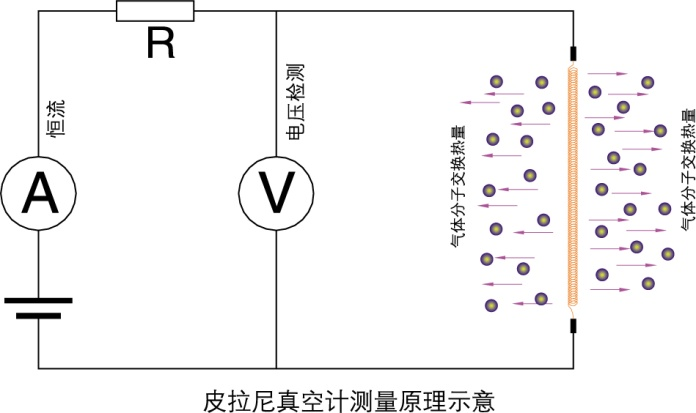
The PRN10 Pirani vacuum gauge works based on the correlation between gas heat conduction and pressure. It infers gas pressure by
measuring the heat dissipation of a heating element (such as a high-temperature resistant filament). The core process and formula
derivation are as follows:
The principle of the Pirani vacuum gauge is: When a constant current (I) flows through a high-temperature resistant filament (resistance R),
the filament heats up. This heat (Q) is exchanged with the surrounding environment in three ways:
1. Gas molecules collide with the filament, carrying away heat Qg.
2. Heat is dissipated through thermal radiation, generating heat Qr.
3. Heat is transferred through solid thermal conduction, generating heat QSt. Therefore, in equilibrium, the following formula holds:
Q = 1/2R = Qg + Qr + Qs. In engineering design, the following conditions must be met: the mean free path of the gas is much larger
than the diameter of the filament; the ambient temperature remains constant; and the filament temperature control remains constant.
Theoretically, we can derive:
12R = AP + 102R
A = n(T - T0)
II. Features of the PRN10 Pirani Vacuum Gauge
Structure and Performance
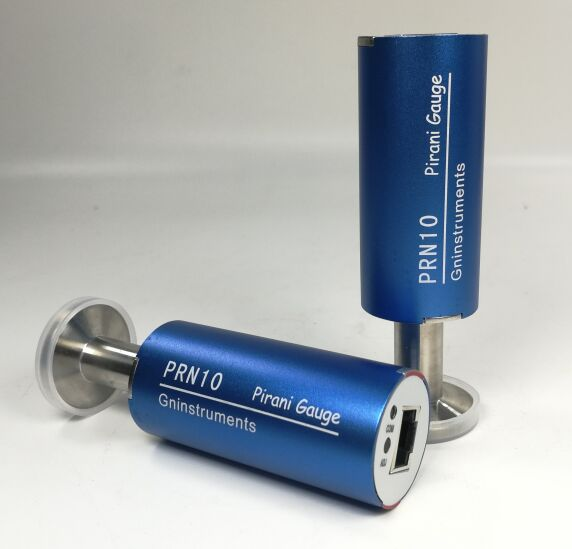
Materials: Vacuum contact parts are made of SS316L stainless steel, offering strong corrosion resistance.
Resolution: Data acquisition resolution reaches 1%, accurately capturing minute pressure changes.
Response Time: <100ms, providing rapid response to pressure fluctuations.
Measurement Range: Optimal range is 10000~0.1Pa (scientific notation: 1.0×10⁻¹ - 1.0×10⁺⁴ Pa), covering low to medium vacuum levels.
Connection Method: Standard configuration is a KF16 vacuum flange; custom KF25 flanges or adapter installations are supported, adapting
to special hose applications.
Application Scenarios
Laboratory Environment: Suitable for common media such as dry air and nitrogen, maintaining high-precision measurement within a
stable range.
Industrial Process Monitoring: Used in processes such as vacuum coating, semiconductor manufacturing, and vacuum drying to monitor
vacuum levels in real time to ensure product quality. Special gas environments: If the system contains solvent vapors, oil mists, acid or
alkali gases (mediums used in reactors), a capacitive thin-film vacuum gauge (such as the CFG500) must be used to avoid measurement
errors.
Usage Precautions
Probe Protection: The probe is susceptible to damage from impacts; avoid rough handling during transportation and installation.
Contamination Control: Vapors, oil mists, or particles in the pipeline may adhere to the heating wire and around the probe, altering
thermal resistance and heat dissipation paths, affecting measurement accuracy. It is recommended to install a dryer filter or cold trap.
Temperature Influence: The dynamic range of the sensing quantity near atmospheric pressure is small and affected by ambient
temperature fluctuations; insulation and cooling measures are required in high-temperature or extreme areas.
III. Alternative Models Reference
For compatibility with other brands, the PRN10 can replace the following models:
Edwards (UK): M-350PG-SD/N25
MKS (USA): 275400-2-GE-T
Leybolt (Germany): 925-11480-0059
Pfeifer (Germany): APG100-XLC
INFICON (Germany): APG-MP-NW16 ST/ST
Other models: TTR91N, TTR96S, YR 20, TPR270 DN 16 ISO-KF, TPR280, PSG500
For more information on Pirani vacuum gauge selection and pricing, please contact CIXIFM Winny:
Email: [email protected]
WhatsApp: 008618049841995

hotline
(86)021-57632436